| Processor | 2 x Intel CPUs, 12 cores per array, 1.7 GHz |
|---|---|
| Functional Type | Unified storage array with all-flash (380F) and hybrid flash (380) models |
| Memory | 128 GB system memory and cache per array |
| Base Enclosure | 2U disk processor enclosure (DPE) with twenty-five 2.5-inch drive slots |
| Drive Enclosure (DAE) | All-flash (F) models: 2.5-inch drives in a 2U twenty-five drive DAE tray |
| Minimum / Maximum Drives | Minimum 6 SSDs or 10 HDDs |
| Maximum Raw Capacity | 2.4 PB |
| RAID Options | 1/0, 5, 6 |
| Max FAST Cache per Array | Up to 800 GB |
| Total Cache | Up to 928 GB (FAST Cache plus system memory) |
| Max Mezzanine Cards per Array | Not supported on the 380F/380 |
| Max IO Modules per Array | 4 (two IO modules per storage processor, mirrored) |
| Back-End SAS Ports | Embedded: 4 x 4-lane 12 Gb/s SAS ports for back-end connection |
| Front-End Ports | Maximum front-end ports (all types): 20 |
| Connectivity Options | Four-port 10Gbase-T module (file and block) |
| Maximum Initiators / Hosts per Array | 512 initiators |
| Maximum Pools per Array | 20 |
| Maximum LUNs per Array | 1,000 |
| Maximum LUN Size | 256 TB |
| Maximum File Systems per Array | 1,000 |
| Maximum File System Size | 256 TB |
| Maximum Snapshots per Array (Block) | 1,000 |
| IOPS (All-Flash Models) | up to 600K IOPS (100% sequential reads, 4K block size, thick LUNs, June 2019 internal testing) |
| Block Protocols | iSCSI, Fibre Channel (FCP SCSI-3) |
| File Protocols | NFSv3, NFSv4, NFSv4.1, NFSv4.2 |
| Supported Media | All-flash SAS SSD: 800 GB, 1.92 TB, 3.84 TB, 7.68 TB, 15.36 TB |
| Drive Security | All drives are 520 bytes/sector |
| Included Software | All-inclusive base software, with no separate licence for core data services |
| Data Efficiency | Thin provisioning |
| Local Data Protection | Controller-based encryption (optional), with self-managed or external key management |
| Remote Data Protection | Native asynchronous block and file replication |
| Optional Software | AppSync Advanced |
| Security and Compliance | DoDIN APL: Unity OE 5.3 listed, or purchased on or before 14-MAR-2024 |
| Management | Unisphere element manager |
| Virtualization Integration | Dell Virtual Storage Integrator (VSI) for VMware vSphere, for provisioning, management and cloning |
| File and Network Services | NAS servers multi-protocol for UNIX and SMB clients (Microsoft, Apple, Samba) |
| Data Migration | Native block and file migration from legacy Dell VNX arrays |
| Rack Size | 2 rack units (2U) |
| Base Unit Weight | 24.60 kg / 54.11 lb (DPE empty) |
| Dimensions | Height: 8.88 cm / 3.5 in. |
| AC Line Voltage | 100 to 240 VAC +/-10%, single phase, 47 to 63 Hz |
| AC Line Current | 10.07 A max at 100 VAC |
| Power Consumption | 1007 VA (970.5 W) max at 100 VAC |
| Heat Dissipation | 3.49 x 10^6 J/hr (3,311 Btu/hr) max at 100 VAC |
| Power Distribution and Protection | Two power supplies per DPE/DAE, each able to power the entire module if its peer is removed or faulted |
| AC Protection | 15 A fuse on each power supply, single line |
| Operating Environment | ASHRAE Equipment Class A4 |
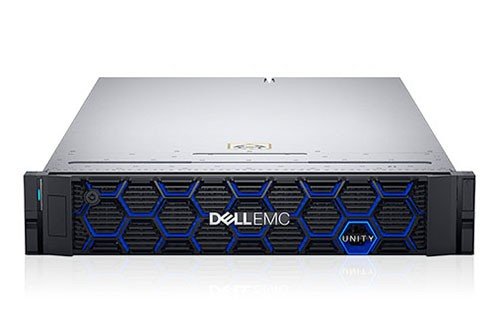
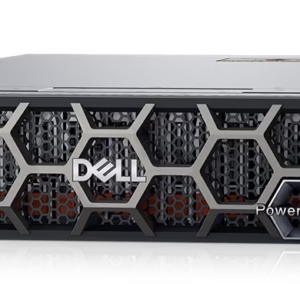
Unity XT 380F/380 Unified Storage
The Unity XT 380F/380 is a 2U unified storage array from the Dell Unity XT family, available as an all-flash model (380F) and a hybrid flash model (380). It pairs dual-active storage processors and two Intel CPUs (12 cores per array, 1.7 GHz) with 128 GB of system memory and cache per array, scales to 500 drives and 2.4 PB of raw capacity, and reaches up to 600K IOPS on the all-flash configuration.
Unity XT 380F/380 Unified Storage Overview
The Unity XT 380F/380 is a unified storage array from the Dell Unity XT family. The pair covers both ends of the flash spectrum: the all-flash 380F model is built for latency-sensitive block and file workloads, while the hybrid 380 model mixes SSDs with 10K and 7.2K NL-SAS drives for workloads that do not need the speed and low latency of an NVMe architecture. Both are built on the same platform: dual-active storage processors with two Intel CPUs (12 cores per array, 1.7 GHz), 128 GB of system memory and cache per array, and a 2U disk processor enclosure holding twenty-five 2.5-inch drives with full 12 Gb SAS back-end connectivity.
Unity XT delivers up to twice the IOPS of the previous Dell Unity models and supports up to 50% more drives, and every array includes a rich set of all-inclusive enterprise software for block, file and VMware vVols. The Unity XT 380F/380 scales to 500 drives and 2.4 PB of raw capacity, and reaches up to 600K IOPS on all-flash configurations. It targets small-scale unified workloads: SMB file serving, virtualisation, databases, and file and print services.
Compute and Memory
- Processors: 2 x Intel CPUs, 12 cores per array, 1.7 GHz
- Memory: 128 GB system memory and cache per array
- Controller design: dual-active storage processors with full 12 Gb SAS back-end connectivity and a multicore architected operating environment
- FAST Cache per array: up to 800 GB (total cache up to 928 GB)
Expansion Capacity
Capacity is added through Disk Array Enclosures (DAEs). All-flash models use 2.5-inch drives in a 2U twenty-five drive tray; hybrid models also support 3.5-inch NL-SAS drives in a 3U fifteen drive tray. All models require four system drives. 107 GB per system drive is consumed by the operating environment software and data structures on the 380F/380 (150 GB per system drive on the 480, 680 and 880 models).
- Minimum drives: 6 SSDs or 10 HDDs per array
- Maximum drives: 500 drives per array
- Maximum raw capacity: 2.4 PB (varies with the drive sizes available at time of purchase)
- Pools: up to 20 per array
- LUNs: up to 1,000 per array, of up to 256 TB each
- File systems: up to 1,000 per array, of up to 256 TB each
- Snapshots: up to 1,000 attached snapshots per array (block)
Connectivity
- Block protocols: iSCSI, Fibre Channel (FCP SCSI-3)
- File protocols: NFSv3, NFSv4, NFSv4.1, NFSv4.2; CIFS (SMB 1), SMB 2, SMB 3.0, SMB 3.02, SMB 3.1.1; FTP and SFTP
- Virtual volumes: VMware Virtual Volumes (vVols) 2.0
- Maximum front-end ports: 20 of all types; 20 Fibre Channel ports; 20 1Gbase-T/iSCSI ports; 20 x 10GbE
16 x 25GbE - Embedded CNA ports: 4 ports: 8/16 Gb FC, 10Gb IP/iSCSI, or 1Gb RJ45
- Maximum initiators and hosts: 512 initiators
64 hosts (dual SP)
32 hosts (single SP) - Back-end connectivity: four embedded 4-lane 12 Gb/s SAS back-end ports (2 x 4 lane buses, 2 x 4 lane maximum)
- Connectivity options: four-port 10Gbase-T, four-port 10GbE optical, four-port 25GbE optical, four-port 32 Gb Fibre Channel (block only) and four-port 12 Gb/s SAS modules
- Direct host attach: Fibre Channel and iSCSI
- Maximum cable lengths: shortwave optical OM4 at 125 m (16 Gb), 190 m (8 Gb), 400 m (4 Gb) and 500 m (2 Gb)
Media
- All-flash SAS SSD: 800 GB, 1.92 TB, 3.84 TB, 7.68 TB, 15.36 TB
- Hybrid SAS SSD: 400 GB (FAST Cache and mixed pools), 800 GB, 1.6 TB, 3.2 TB (mixed pools), 7.68 TB (all-flash)
- 10K SAS HDD: 600 GB, 1.2 TB, 1.8 TB
- 7.2K NL-SAS HDD: 4.0 TB, 6.0 TB, 12.0 TB (3.5-inch tray only)
All drives are 520 bytes/sector and non-SED; data at rest encryption is performed by the storage controller. RAID options are 1/0, 5 and 6.
Software and Data Services
- Included software: all-inclusive base software covering management, unified protocols, local and remote protection, and migration, with no separate licence for core data services
- Efficiency: thin provisioning, dynamic pools, inline data reduction (zero detect, deduplication, compression), and a Future Proof guaranteed 3:1 data reduction rate on all-flash models
- Hybrid optimisation: FAST Cache (up to 800 GB per array) and FAST VP
- Local protection: snapshots and thin clones, up to 1,000 attached snapshots per array, AppSync Basic, and File-Level Retention (FLR-E and FLR-C)
- Remote protection: native asynchronous and synchronous block and file replication, MetroSync Manager, snapshot shipping and RecoverPoint Basic
- Cloud tiering: file and block tiering and archiving to public or private clouds through the Cloud Tiering Appliance
- Migration: native block and file migration from legacy Dell VNX, and SAN Copy Pull for third-party arrays
Security and Compliance
- DoDIN APL for Unity OE 5.3 (listed, or purchased on or before 14-MAR-2024) and Common Criteria
- Controller-based Data at Rest Encryption (D@RE) with self-managed keys, plus a KMIP-compliant external key manager
- FIPS 140-2 Level 1 validation and native SHA2 certificate
- IPv6 and dual stack (IPv4) modes of operation
- Security Technical Implementation Guide / Security Requirements Guide (STIG/SRG)
- TLS 1.3 and 1.2 support, with TLS 1.0/1.1 disablement
- File-Level Retention Enterprise (FLR-E) and Compliance (FLR-C), meeting SEC rule 17a-4(f)
- Restriction of Hazardous Substances (RoHS) compliance
Management and Ecosystem Support
Management is through Unisphere, Unisphere Central, CloudIQ and an open REST API, with Proactive Assist for remote support and Quality of Service for block, file and vVols. Supported ecosystems include Dell Virtual Storage Integrator for VMware vSphere, VMware SRM, VAAI and VASA, OpenStack Cinder and Manila drivers, the Ansible module for Unity, a Container Storage Interface driver and the vRealize Orchestrator plug-in. Optional solutions include AppSync Advanced, Connectrix SAN, RecoverPoint Advanced, RP4VM, PowerPath Multipathing and PowerPath Migration Enabler, Unity XT metro node and VPLEX.
Data Mobility
- Block migration: native migration from legacy Dell VNX arrays, plus SAN Copy Pull for integrated block migration from third-party arrays
- File migration: native file migration from legacy Dell VNX arrays
Physical Specifications
- Rack size: 2 rack units (2U) disk processor enclosure
- Weight: 24.60 kg / 54.11 lb (DPE empty)
- Dimensions: 8.88 cm / 3.5 in. height x 44.76 cm / 17.62 in. width x 61.39 cm / 24.17 in. depth
- Drive enclosures: 2U twenty-five 2.5-inch drive DAE, and a 3U fifteen 3.5-inch drive DAE for hybrid models
- Environment class: ASHRAE Equipment Class A4
Power and Heat Dissipation
- Input: 100 to 240 VAC +/-10%, single phase, 47 to 63 Hz
- Line current: 10.07 A max at 100 VAC; 5.04 A max at 200 VAC
- Power consumption: 1007 VA (970.5 W) max at 100 VAC; 1007 VA (970.5 W) max at 200 VAC
- Heat dissipation: 3.49 x 10^6 J/hr (3,311 Btu/hr) max at 100 VAC; 3.49 x 10^6 J/hr (3,311 Btu/hr) max at 200 VAC
- Redundancy: two power supplies per DPE or DAE, each able to power the entire module, with a battery backup unit for the DPE and a 0.95 minimum power factor at full load
- In-rush and surge current: 45 Apk cold and 120 Apk hot per line cord at any line voltage; 10 ms minimum ride-through time
- AC protection: 15 A fuse on each power supply, single line
Operating Environment
- ASHRAE class: ASHRAE Equipment Class A4
- Recommended range: 18 °C to 27 °C (64.4 °F to 80.6 °F) at 5.5 °C (59 °F) dew point
- Continuous allowable range: 5 °C to 35 °C (50 °F to 95 °F) at 20% to 80% relative humidity with 21 °C (69.8 °F) maximum dew point
- Improbable operation (excursion limited): 35 °C to 40 °C, limited to 10% or less of annual operating hours
- Exceptional (excursion limited): 40 °C to 45 °C (with no direct sunlight on the equipment), limited to 1% or less of annual operating hours
- Temperature gradient: 20 °C per hour (36 °F per hour)
- Maximum operating altitude: 3,050 m (10,000 ft)
Configuration, availability and lead time depend on the required model, drive mix, protocols and delivery destination. Send your requirement to receive a quotation.