| Array Family | PowerMax 2500 |
|---|---|
| Array Type | Scale-out all-flash enterprise storage array |
| Operating System | PowerMaxOS 10 |
| Node Pairs | 1 to 2 |
| Node Pair Module | 3U |
| Processor | Memory config 1-3: Intel Xeon Gold 5218 2.8 GHz, 16 cores per CPU |
| Cores per CPU / Node Pair / System | Memory config 1-3: 16 / 64 / 128 |
| Dynamic Fabric | Direct connection InfiniBand: 100 Gbps per port |
| Cache per Node Pair | 896 GB, 1.792 TB, 3.584 TB, 7.680 TB |
| Cache per System (Raw) | Minimum 896 GB raw, maximum 15.36 TB raw |
| Vault Strategy | Vault to Flash |
| Vault Implementation | 2 to 4 NVMe SED flash modules per node pair |
| Maximum Front-End I/O Modules per Node Pair | 8 |
| Maximum Capacity per Array (Open Systems) | 8 PiBe / 8.8 PBe maximum per array |
| Base Capacity (Open Systems) | 30.72 TBu |
| Maximum Capacity per Array (Mainframe) | 3.8 PiBe / 4.1 PBe maximum per array |
| Base Capacity (Mainframe) | 15.36 TBu |
| Data Reduction Guarantee | 5:1 open systems / 3:1 mainframe |
| Response Time | Under 60 microseconds |
| Maximum Drives per Array | 96 |
| Maximum Drives per System Bay | 96 / 192 / 288 |
| Minimum Drive Count per System | 6 (mainframe) / 10 (open systems) |
| NVMe Drive Capacities | 3.84 TB, 7.68 TB, 15.36 TB, 30.72 TB (2.5 inch) |
| Incremental Flash Capacity Upgrades | TLC: 3.84 TB, 7.68 TB, 15.36 TB, 30.72 TB |
| Drive Interface | Dual PCIe Gen 3 x8 NVMe attached interface; NVMe and NVMe-oF over a dual 100 Gb InfiniBand fabric |
| RAID Support | RAID 1 (1+1) |
| Mixed RAID Group Support | No |
| Support for Mixed Drive Capacities | Yes, up to two consecutive compatible capacities |
| Dynamic Media Enclosure | 48 x 2.5-inch drive DME |
| Host Support | Open systems, mainframe, and mixed mainframe and open systems |
| 100 Gb/s Ethernet / iSCSI / NVMe-TCP / SRDF Ports | 16 per node pair / 32 per array |
| 64 Gb/s FC / NVMe / SRDF Ports | 32 per node pair / 64 per array |
| 32 Gb/s FC / FICON / SRDF Ports | 32 per node pair / 64 per array |
| 25 Gb/s Ethernet / iSCSI / NVMe-TCP Ports | 32 per node pair / 64 per array |
| 10 Gb/s Ethernet / iSCSI / NVMe-TCP Ports | 32 per node pair / 64 per array |
| zHyperlink Ports | 2 per node pair / 4 per array |
| Maximum File I/O Modules per Array | 4 |
| File I/O Modules Supported | 10 Gb/s: 4 x 10Gb/s file; 25 Gb/s: 4 x 25Gb/s file |
| Software File Nodes | 4 software file nodes (1 per node, 2 per node pair) |
| Maximum File Capacity per Array | 8 PiBe maximum file capacity per array |
| Max Devices / Secure Snapshots | 64K LUNs / 65M snapshots |
| Thin Provisioning | 100% thin provisioned pre-configured from factory |
| Availability | Designed for six nines of availability |
| Pre-Configuration from Factory | 100% thin provisioned |
| System Bay Configuration | Up to 3 systems per bay |
| System Bay Dispersion | Not applicable – the PowerMax 2500 is a single floor tile, single-bay solution |
| Standard 19 inch Bays | Yes, third-party rack mount option available |
| Height | 78.4 inch (199.2 cm) |
| Width | 23.5 inch (60 cm) |
| Depth | 45.2 inch (114.8 cm) |
| Weight | 675 lb (306 kg) – single node pair, single DME |
| Power Options | Single phase or three-phase; delta or wye |
| Intelligent PDU | Included by default with PowerMaxOS 10.1 |
| Single Phase Input | 200 – 240 VAC +/- 10% L-L or 220 – 240 VAC +/- 10% L-N; 50 – 60 Hz; 30 A (or 30/32 A) circuit breakers; two power zones |
| Three Phase Input | 200 – 240 VAC +/- 10% L-L (delta 4-wire, 50 A) or 220 – 240 VAC +/- 10% L-N (wye 5-wire, 30/32 A); 50 – 60 Hz; two power zones |
| Operating Environment | ASHRAE 2-level operating condition class, 10 C to 35 C with corresponding relative humidity |
| Services and Warranty | Dell ProDeploy Enterprise Suite, ProSupport Enterprise Suite, Managed Services for Storage and Cyber Recovery Services for PowerMax (Cyber Vault) |
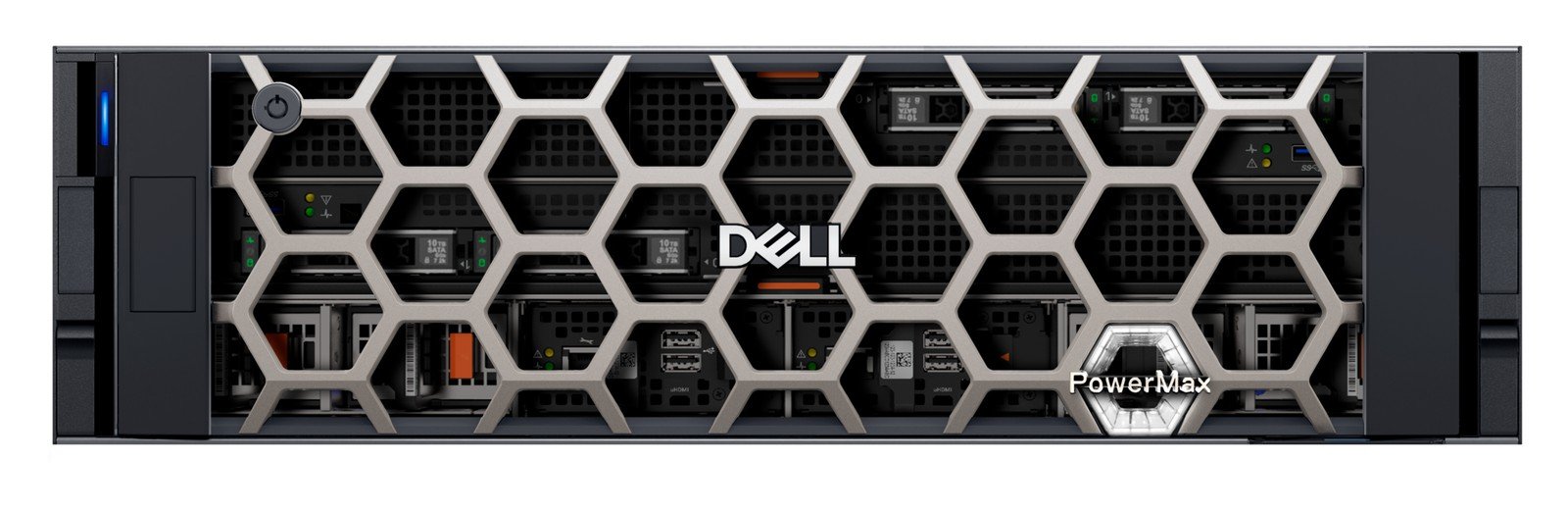
PowerMax 2500 All-Flash Storage
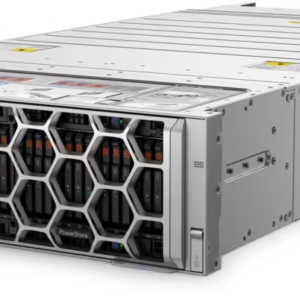
The Dell PowerMax 2500 All-Flash Storage is a scale-out all-flash enterprise storage array with 1 to 2 node pairs, up to 8 PiBe / 8.8 PBe of effective capacity and 100 Gb/s InfiniBand dynamic fabric. It delivers sub-60-microsecond response times with a 5:1 data reduction guarantee for open systems and 3:1 for mainframe.
PowerMax 2500 All-Flash Storage Overview
The PowerMax 2500 delivers up to 7x more effective capacity (8 PBe) in half the footprint of previous models. With the industry’s most comprehensive data services, it is designed to handle demanding mixed workloads – block, file and mainframe – while ensuring the highest levels of data availability and cyber resiliency.
PowerMax is built from modular storage components. The compute modules are packaged as node
pairs, each containing two PowerMax compute nodes with complete software and licensing, cache
memory, redundant power and connectivity modules. These are combined with 48-slot Dynamic Media
Enclosures (DMEs) to configure NVMe flash drives. Arrays are delivered with the Inclusive Software
package, and NVMe drive capacity can be added in single-drive increments to scale up to 8 PiBe / 8.8 PBe maximum per array.
Both models carry an industry-leading data reduction guarantee of 5:1 for open systems and 3:1 for
mainframe.
Compute, Cache and Vault
- Node pairs: 1 to 2
- Node pair module: 3U
- Processor options: Memory config 1-3: Intel Xeon Gold 5218 2.8 GHz, 16 cores per CPU
Memory config 4-5: Intel Xeon Gold 6240L - Cores per CPU / node pair / system: Memory config 1-3: 16 / 64 / 128
Memory config 4-5: 18 / 72 / 144 - Dynamic fabric: Direct connection InfiniBand: 100 Gbps per port
- Cache per node pair: 896 GB, 1.792 TB, 3.584 TB, 7.680 TB
- Cache per system (raw): Minimum 896 GB raw, maximum 15.36 TB raw
- Vault strategy: Vault to Flash
- Vault implementation: 2 to 4 NVMe SED flash modules per node pair
- Maximum front-end I/O modules per node pair: 8
Capacity and Drives
- Maximum capacity per array (open systems): 8 PiBe / 8.8 PBe maximum per array based on 5:1 data
reduction - Base capacity (open systems): 30.72 TBu
- Maximum capacity per array (mainframe): 3.8 PiBe / 4.1 PBe maximum per array based on 3:1 data
reduction - Base capacity (mainframe): 15.36 TBu
- Maximum drives per array: 96
- Maximum drives per system bay: 96 / 192 / 288
- Minimum drive count per system: 6 (mainframe) / 10 (open systems)
- NVMe drive capacities: 3.84 TB, 7.68 TB, 15.36 TB, 30.72 TB (2.5 inch)
- Incremental flash capacity upgrades: TLC: 3.84 TB, 7.68 TB, 15.36 TB, 30.72 TB
QLC: 15.36 TB, 30.72 TB - Dynamic media enclosure: 48 x 2.5-inch drive DME, supported on both models
- Drive interface: dual PCIe Gen 3 x8 NVMe attached; NVMe and NVMe-oF over a
dual 100 Gb InfiniBand fabric - Flexible RAID options: RAID 1 (1+1)
RAID 5 (4+1) – mainframe only, 3.84 TB drives only
RAID 5 (8+1)
RAID 5 (12+1)
RAID 6 (12+2)
RAID 6 (24+2) – 15.36 TB and 30.72 TB drives only - Mixed RAID group support: no
- Support for mixed drive capacities: yes, up to two consecutive compatible
capacities per storage resource pool
Front-End Connectivity
- Protocols supported: 2 x 100 Gb/s Ethernet, iSCSI, SRDF and NVMe/TCP;
4 x 64 Gb/s Fibre Channel, NVMe and SRDF; 4 x 32 Gb/s Fibre Channel, NVMe/FC, FICON and SRDF;
4 x 25 Gb/s Ethernet, iSCSI, SRDF and NVMe/TCP; 4 x 10 Gb/s Ethernet, iSCSI, SRDF and NVMe/TCP;
1 x zHyperlink port for mainframe and zHyperlink - 100 Gb/s Ethernet, iSCSI, NVMe/TCP and SRDF ports: 16 per node pair / 32 per array
- 64 Gb/s Fibre Channel, NVMe and SRDF ports: 32 per node pair / 64 per array
- 32 Gb/s Fibre Channel, FICON and SRDF ports: 32 per node pair / 64 per array
- 25 Gb/s Ethernet, iSCSI and NVMe/TCP ports: 32 per node pair / 64 per array
- 10 Gb/s Ethernet, iSCSI and NVMe/TCP ports: 32 per node pair / 64 per array
- zHyperlink ports: 2 per node pair / 4 per array
PowerMax File
- Maximum file I/O modules per array: 4
- File I/O modules supported: 10 Gb/s – 4 x 10Gb/s file; 25 Gb/s – 4 x 25Gb/s
file - Software file nodes: 4 software file nodes (1 per node, 2 per node pair)
- Maximum file capacity per array: 8 PiBe maximum file capacity per array
Availability, Data Services and Security
- Architecture: end-to-end NVMe, InfiniBand 100 Gb/s, dual-ported NVMe flash
drives, NVMe/TCP connectivity and hardware-based data reduction, designed for six nines of
availability - Data reduction: advanced global inline data reduction, with a 5:1 guarantee
for open systems and 3:1 for mainframe - Operating system: PowerMaxOS 10
- Host support: open systems, mainframe, and mixed mainframe and open systems
- Pre-configuration from factory: 100% thin provisioned
- Cyber resiliency: Cyber Recovery Service for PowerMax (cyber vault) available
through Dell Professional Services - Scalability: independent growth of nodes and storage capacity in single-drive
increments with Dynamic Fabric architecture and Flexible RAID
Physical and Power Specifications
- System bay configurations: Up to 3 systems per bay
- System bay dispersion: Not applicable – the PowerMax 2500 is a single floor tile, single-bay solution
- Standard 19 inch bays: yes, third-party rack mount option available
- Height: 78.4 inch (199.2 cm)
- Width: 23.5 inch (60 cm)
- Depth: 45.2 inch (114.8 cm)
- Weight: 675 lb (306 kg) – single node pair, single DME
813 lb (369 kg) – dual node pair, single DME
900 lb (408 kg) – dual node pair, dual DME
1125 lb (510 kg) – three node pair, three DME
1375 lb (624 kg) – four node pair, four DME
1838 lb (834 kg) – six node pair, six DME - Power options: single phase or three-phase, delta or wye
- Intelligent PDU: included by default with PowerMaxOS 10.1, enabling real-time
telemetry and monitoring of power, voltage, current, external temperature and humidity - Single phase input: 200 – 240 VAC +/- 10% line-to-line nominal (North
American 3-wire) or 220 – 240 VAC +/- 10% line-to-neutral nominal (international and Australian
3-wire); 50 – 60 Hz; 30 A circuit breakers (30 or 32 A international); two power zones - Three-phase input: 200 – 240 VAC +/- 10% line-to-line nominal (North American
delta, 4-wire, 50 A) or 220 – 240 VAC +/- 10% line-to-neutral nominal (international wye, 5-wire,
30/32 A); 50 – 60 Hz; two power zones - Radio frequency interference: certified to EN61000-4-3; maximum ambient RF
field strength should not exceed 3 volts per metre in data centers with intentional radiators
Operating Environment
Tested and verified to work within the permitted range of the ASHRAE 2-level operating condition
class between 10 C and 35 C and within the corresponding relative humidity range.
Services and Warranty
- Implementation: Dell ProDeploy Enterprise Suite, Dell Data Migration Services,
Dell Residency Services, Dell Data Sanitization Services for Enterprise - Support: Dell ProSupport Enterprise Suite, Dell Keep Your Hard Drive for
Enterprise - Managed and consulting: Dell Managed Services for Storage; Cyber Recovery
Services for PowerMax (Cyber Vault); advisory services workshops - Support technology: MyService360, Secure Remote Services, SupportAssist
Enterprise
Ordering
Configuration, availability and lead time depend on the required model, drive mix, protocols and delivery destination. Send your requirement to receive a quotation.