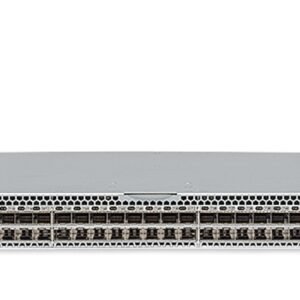
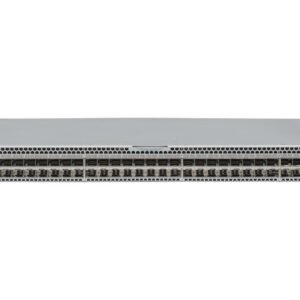
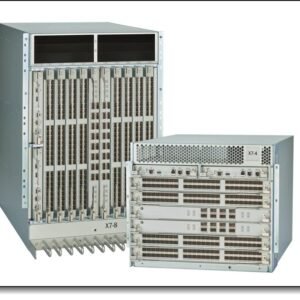
| Product Family | Connectrix B-Series ED-DCX7 Enterprise Director, 64 Gb/s |
|---|---|
| Model | ED-DCX7-8B, Dell order code Dell order code 210-AWYK |
| Form Factor | 14U (61.23 cm / 24.11 in. high), rack-mountable in a standard 19-inch EIA cabinet |
| Blade Slots | Eight vertical blade slots |
| Fibre Channel Ports | Up to 384 x 64 Gb/s line-rate ports for device connectivity, or up to 512 x 32 Gb/s line-rate ports, universal (E_Port, F_Port, EX_Port, M_Port, D_Port, SIM Port, FICON) |
| Inter-Chassis Link Ports | 32 Inter-Chassis Link (ICL) connections, providing 128 ports for chassis-to-chassis interconnect |
| Aggregate Chassis Bandwidth | 30.9 Tb/s with 48-port 64G blades (384 device ports at 64G plus 32 ICLs); 39.6 Tb/s with 64-port 64G blades (512 device ports at 64G plus 32 ICLs); 22.8 Tb/s with 64-port 32G blades (512 device ports at 32G plus 32 ICLs) |
| Chassis Bandwidth | 31 Tb/s per chassis with 384 device ports plus 32 ICL connections supporting 128 ports |
| Slot Bandwidth | 3,072 Gb/s providing line-rate performance for the port blades |
| Port Blade Options | 48 x 64 Gb/s (backward compatible to 8, 10, 16 and 32 Gb/s); 48 x 32 Gb/s (backward compatible to 4, 8, 10 and 16 Gb/s); 64 x 64 Gb/s via 32 x 64G SFP-DD optics |
| Extension Blade | 16 x 32 Gb/s Fibre Channel ports, 16 x 1/10GbE ports and 2 x 40GbE ports for FC and IP storage replication over distance |
| AnyIO Ports | 24 AnyIO ports configurable as Fibre Channel or IP: 8, 16, 32 and 64G Fibre Channel or 10, 25 and 50GbE IP speeds, the latter requiring the 64G SWL SFP+ transceiver |
| Port-to-Port Latency | 460 ns local switching at 64 Gb/s including FEC; 1.4 µs blade-to-blade |
| ISL Trunking | Frame-based trunking with up to eight 64 Gb/s ports per ISL trunk and up to 512 Gb/s per trunk; exchange-based load balancing with DPS included in Fabric OS |
| ICL Trunking | Chassis-to-chassis linkage via connectors on the Core Routing (CR) blade, with up to four QSFP ports per trunk group and a minimum of two QSFP connections per trunk |
| Maximum Frame Size | 2,112-byte payload |
| Frame Buffers | 24,000 per switching ASIC |
| Classes of Service | Class 2, Class 3, Class F (inter-switch frames) |
| ANSI Fibre Channel Protocol | FC-PH (Fibre Channel Physical and Signaling Interface standard) |
| Scalability / Certified Maximum | Full-fabric architecture of 239 switches; 6,000 active devices per switch, 56 switches and 19 hops in FOS fabrics |
| Multi-Chassis Scale | Up to 4,608 Fibre Channel ports; up to 9 chassis full mesh or 12 chassis core-edge |
| Media Types | 64G and 32G FC SFP+ LC (SWL, LWL, ELWL); 64G FC SFP-DD SN (SWL); 16G FC SFP+ LC; 10GbE, 1GbE SFP+ LC and 1GbE copper on the extension blade; FC QSFP+ multimode (SWL 100 m) and single-mode (LWL 2 km) on the CR blades. All B-Series transceivers are PC/UPC compatible |
| Fabric Services | BB Credit Recovery; Advanced Zoning (Default Zoning, Port/WWN Zoning, Peer Zoning); Congestion Signaling; Dynamic Path Selection (DPS); Extended Fabrics; Fabric Performance Impact Notification; Fabric Vision; FDMI; FICON CUP; Flow Vision; F_Port Trunking; FSPF; Integrated Routing; ISL Trunking; Management Server; Name Server; NPIV; NTP v3; Port Decommission/Fencing; QoS; Registered State Change Notification (RSCN); Target-Driven Zoning; Traffic Optimizer; Virtual Fabrics (Logical Switch, Logical Fabric); VMID+ and AppServer |
| Extension | DWDM, CWDM and FC-SONET; in-flight compression (LZO) and AES-GCM-256 encryption; FCIP; IP Extension; Adaptive Rate Limiting (ARL); data compression; Fast Write; read/write tape pipelining; QoS |
| FICON | FICON cascading, lossless DLS, FICON CUP and the Advanced Accelerator for FICON (IBM z/OS Global Mirror and read/write tape pipelining) |
| Management | Advanced Web Tools; Brocade SANnav Management Portal and SANnav Global View; CLI; HTTP/HTTPS; RESTful API; SSH; SNMP v1/v3 (FE MIB, FC Management MIB); trial licences for add-on capabilities |
| Management Access | 10/100/1000Mb/s Ethernet (RJ-45) per control processor; serial console port (RJ-45) and one USB per control processor module; DHCP/DHCPv6; call-home integration via SANnav Management Portal |
| Security | AES-GCM-256 encryption on FC ISLs (E_Port); Device Connection Control (DCC); DH-CHAP; Fabric Configuration Server (FCS); FCAP switch authentication; FIPS 140-2 compliant; HTTPS; IP filtering; LDAP with IPv6; OpenLDAP; RADIUS; user-defined RBAC; Secure Boot; Secure Copy (SCP); SFTP; SSH v2; Switch Binding; TACACS+; TLS v1.2/v1.3; USGv6 compliant |
| Diagnostics | Active Support Connectivity (ASC) and Brocade Support Link (BSL); built-in flow generator; ClearLink optics and cable diagnostics including electrical/optical loopback and link traffic/latency/distance; Fabric Performance Impact Monitoring (FPI); flow mirroring; Forward Error Correction; frame viewer; IO Insight for SCSI and NVMe monitoring; Monitoring and Alerting Policy Suite (MAPS); non-disruptive daemon restart; optics health monitoring; POST and embedded online/offline diagnostics including environmental monitoring, FCping and Pathinfo (FC trace route); power monitoring; RAStrace logging; Rolling Reboot Detection (RRD); Syslog/Audit Log; VM Insight |
| High Availability | Non-blocking shared memory, passive backplane, redundant active/passive control processor, redundant active/active core switching blades and redundant WWN cards |
| Power Supplies | Four power supplies required for AC low-line (100-120 VAC); two required for AC high-line (200-240 VAC). Chassis ships empty only, PSUs and fans ordered separately. Three PSUs give 2+1 redundancy; four must be installed for full power efficiency and 2+2 redundancy |
| Cooling | Three fan tray assemblies required; each assembly holds two fans (6 total), and 5 of 6 fans must be operational |
| Airflow | Non-port-side intake (NPI) to port-side exhaust, or port-side intake to non-port-side exhaust (NPE) |
| Heat Dissipation and Power | 64 Gb/s 384-port configuration including ICLs: typical 10,953 Btu/hr. Power consumed: typical 3,210 W, maximum 4,550 W at 200 VAC with full PSU redundancy. The Dell spec sheet also prints a maximum of 158,530 Btu/hr for this configuration, which is inconsistent with its own 4,550 W maximum power figure and appears to be a typographical error |
| Power Supply Certification | Standard AC power supplies, 80 PLUS Platinum certified; optional high-voltage (HV) power supplies available |
| Input Voltage | Standard AC 90-264 VAC auto-volt, nominal 100-240 VAC: 85-132 VAC delivers 1,450W and 180-264 VAC delivers 2,870W. HV supplies additionally support 192-400 VDC nominal 240-380 VDC |
| Input Line Frequency | 50-60 Hz |
| Inrush Current | 35 A maximum, peak |
| Dimensions (H x W x D) | 61.23 cm x 43.74 cm x 61.04 cm (24.11 in. x 17.23 in. x 24.04 in.), 14U |
| Weight | 35.61 kg (78.5 lb) for the chassis; 145.8 kg (321.5 lb) maximum fully populated |
| Operating Environment | 0°C to 40°C (32°F to 104°F); 5% to 93% RH non-condensing at 40°C with a maximum gradient of 10% per hour; altitude up to 3,000 m (9,842 ft); operating shock 10g, 11 ms half-sine; operating vibration 0.5 Grms (5-500 Hz) |
| Non-Operating Environment | -25°C to 70°C (-13°F to 158°F); 10% to 93% RH non-condensing at 70°C; non-operating shock 20g, 11 ms half-sine; non-operating vibration 1.12 Grms |
| Services and Warranty | Dell Technologies Services cover the full lifecycle of a SAN build-out: Consulting Services for design and planning, ProDeploy Enterprise Suite for deployment through planning, configuration and complex integrations, Residency and Managed Services for ongoing operations, and ProSupport Enterprise Suite for expert support backed by proactive and predictive AI tools. |
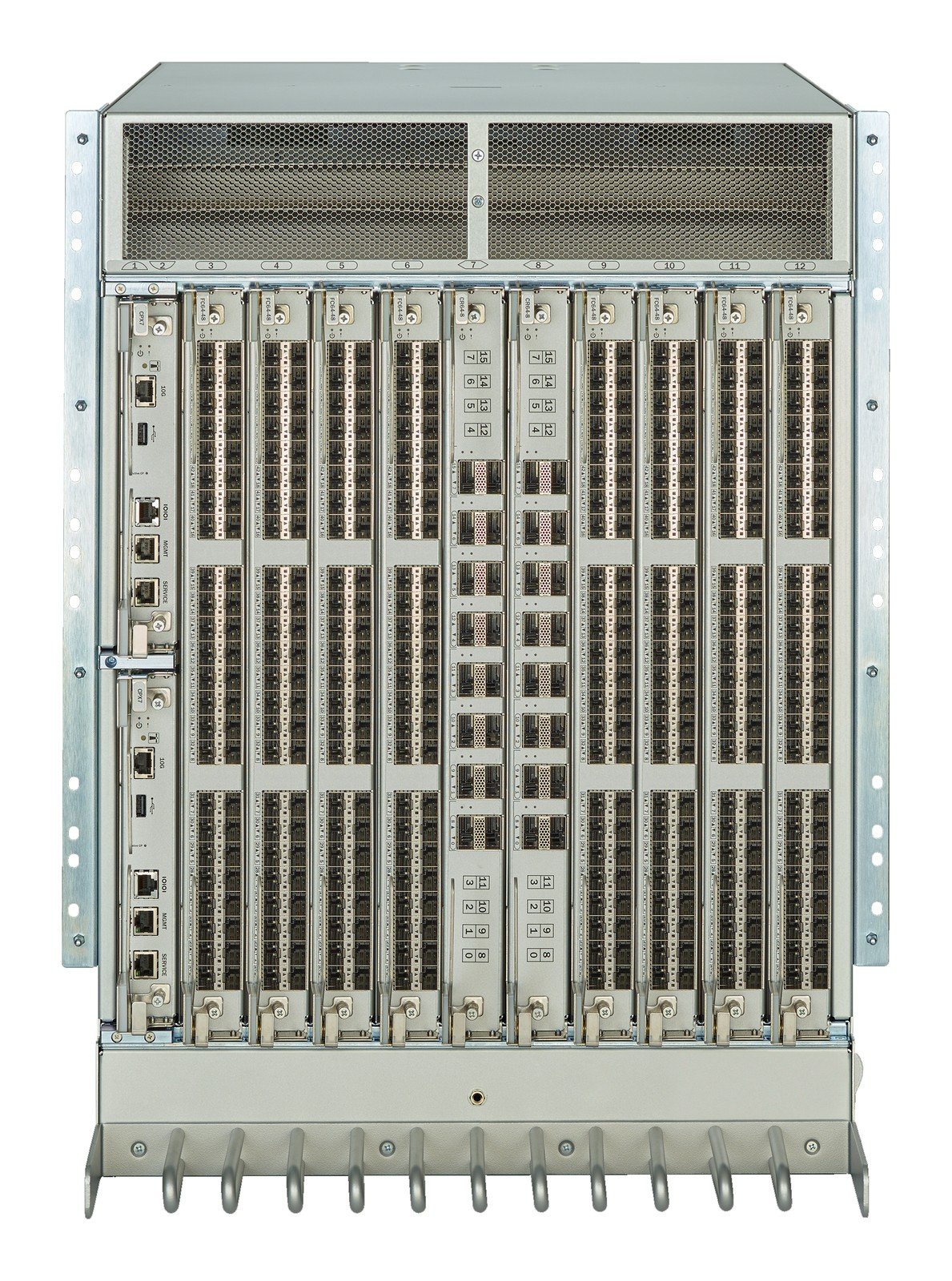
Connectrix ED-DCX7-8B 64G Fibre Channel Director
The Dell Connectrix ED-DCX7-8B is a 14U, 64Gb/s Fibre Channel enterprise director: eight vertical blade slots support up to 384 x 64G ports (or 512 x 32G), 32 Inter-Chassis Links add 128 interconnect ports, and the chassis delivers up to 39.6 Tb/s of aggregate bandwidth.
Overview
The Connectrix ED-DCX7-8B is the 14U member of the 64 Gb/s ED-DCX7 enterprise director family. Eight vertical blade slots carry up to 384 x 64 Gb/s line-rate ports, or up to 512 x 32 Gb/s line-rate ports, and 32 Inter-Chassis Link connections add 128 ports for director-to-director interconnect. With a 50% latency reduction against the previous generation, the director maximises the performance of NVMe storage and high-transaction workloads and removes I/O bottlenecks.
Chassis and Port Configuration
- Model: ED-DCX7-8B (Dell order code 210-AWYK)
- Form factor: 14U (61.23 cm / 24.11 in. high), rack-mountable in a standard 19-inch EIA cabinet
- Blade slots: Eight vertical blade slots
- Fibre Channel ports: Up to 384 x 64 Gb/s line-rate ports for device connectivity, or up to 512 x 32 Gb/s line-rate ports, provided by (E, F, D, M, SIM and EX)
Fibre Channel ports on the port blades - Inter-Chassis Link ports: 32 Inter-Chassis Link (ICL) connections, providing 128 ports for chassis-to-chassis interconnect
- Aggregate chassis bandwidth: 30.9 Tb/s with 48-port 64G blades (384 device ports at 64G plus 32 ICLs); 39.6 Tb/s with 64-port 64G blades (512 device ports at 64G plus 32 ICLs); 22.8 Tb/s with 64-port 32G blades (512 device ports at 32G plus 32 ICLs)
- Chassis bandwidth: 31 Tb/s per chassis with 384 device ports plus 32 ICL connections supporting 128 ports
- Slot bandwidth: 3,072 Gb/s, providing line-rate performance per port blade
slot - Control processor: redundant active/standby control processor modules
Fibre Channel Blades and Port Blades
- FC128-48 port blade (ED-DCX8): 48 x 128 Gb/s ports, each supporting 128, 64,
32 and 16 Gb/s Fibre Channel or 100, 50, 25 and 10GbE Ethernet speeds - ED-DCX7 48-port 64G blade: 48 x 64 Gb/s Fibre Channel ports with
backward-compatible support for 8, 10, 16 and 32 Gb/s connectivity - ED-DCX7 48-port 32G blade: 48 x 32 Gb/s Fibre Channel ports with
backward-compatible support for 4, 8, 10 and 16 Gb/s connectivity, in short-wave and long-wave
models - ED-DCX6/7 SAN Extension blade: 16 x 32 Gb/s Fibre Channel ports, 16 x
1/10GbE ports and 2 x 40GbE ports for long-distance replication and disaster recovery
Blade order codes for ED-DCX7: 210-BBHK and 210-BSFV (48 x 64 Gb/s, SW and LW), 210-BJPM
(64 x 64 Gb/s via 32 x 64G SFP-DD), 210-AWYL and 210-AWYM (48 x 64 Gb/s populated with 32 Gb/s
SW and LW optics), 210-AWYN and 210-AWYO (48 x 32 Gb/s SW and LW), 210-AWUP (extension blade).
Performance
- FC64-48 port blade: 8.5, 10.53, 14.025, 28.05 and 57.8 Gb/s line speed,
full duplex; auto-sensing of 8, 16, 32 and 64G port speeds depending on the SFPs used, with 10G
port speeds on dedicated SFPs - FC64-64 port blade: 8.5, 14.025, 28.05 and 57.8 Gb/s line speed, full
duplex; auto-sensing of 8, 16, 32 and 64G port speeds depending on the SFPs used, where 8G
requires a 32G SFP+ LWL or ELWL transceiver - FC32-48 port blade: 4.25, 8.5, 10.53, 14.025 and 28.05 Gb/s line speed,
full duplex; auto-sensing of 4, 8, 16 and 32G port speeds - AnyIO ports: 24 AnyIO ports can be configured as Fibre Channel or IP,
supporting 8, 16, 32 and 64G Fibre Channel or 10, 25 and 50GbE IP speeds. Support for 10, 25 and
50GbE requires the 64G SWL SFP+ transceiver - ISL trunking: frame-based trunking with up to eight 64 Gb/s ports per ISL
trunk and up to 512 Gb/s per trunk, with exchange-based load balancing across ISLs using DPS
included in Fabric OS - ICL trunking: chassis-to-chassis linkage through connectors on the Core
Routing (CR) blade, up to four QSFP ports in a trunk group; a minimum of two QSFP connections is
required for a trunk - Port-to-port latency: 460 ns local switching at 64 Gb/s (including FEC as
part of the Fibre Channel standard); 1.4 µs blade-to-blade - Maximum frame size: 2,112-byte payload
- Frame buffers: 24,000 per switching ASIC
- Classes of service: Class 2, Class 3 and Class F (inter-switch frames)
- ANSI Fibre Channel protocol: FC-PH (Fibre Channel Physical and Signaling
Interface standard) - Data traffic types: fabric switches supporting unicast
Autonomous SAN and Management
The ED-DCX7 lays the foundation for the Connectrix B-Series autonomous SAN. The director
harnesses analytics and automation to optimise performance, ensure reliability and simplify
management, enabling a self-learning, self-optimising and self-healing SAN.
- Self-learning SAN: integrated network sensors gather and transform millions
of I/O performance and behaviour data points into actionable intelligence - SANnav Management Portal: displays captured telemetry so problems can be
identified and isolated before they affect application availability - Best-practice recommendations: built-in guidance simplifies troubleshooting
and shortens time to resolution - Automated correction: detects abnormal traffic behaviour and degraded
performance and takes corrective action automatically
Scalability and Extension
- Maximum fabric: full-fabric architecture of 239 switches; certified maximum
of 6,000 active devices per switch, 56 switches and 19 hops in Fabric OS fabrics, with larger
fabrics certified as required - Multi-chassis: up to 4,608 Fibre Channel ports; ICL ports (32 for the 8-slot
and 16 for the 4-slot chassis, optical QSFP) connect up to 9 chassis in a full-mesh topology or
up to 12 chassis in a core-edge topology - Extension: supports DWDM, CWDM and FC-SONET devices, Fibre Channel in-flight
compression (LZO) and AES-GCM-256 encryption, BB Credit Recovery, FCIP, IP Extension, Adaptive
Rate Limiting (ARL), data compression, Fast Write, read/write tape pipelining and QoS - Media types: 64G FC SFP+ LC (SWL, LWL, ELWL) and 32G FC SFP+ LC (SWL, LWL,
ELWL) on port blades; 64G FC SFP-DD SN (SWL) on the 64-port blade; 32G and 16G FC SFP+ LC, 10GbE
SFP+ LC, 1GbE SFP+ LC and 1GbE copper on the extension blade; FC QSFP+ multimode (MPO, SWL 100 m)
and single-mode (LC, LWL 2 km) and 4x32G FC QSFP+ multimode on the CR blades. All B-Series
transceivers are PC/UPC compatible - USB: one USB port per control processor for firmware download, SupportSave
and configuration upload or download
Security
Fabric-level security is built into the director rather than bolted on, covering switch
authentication, in-flight ISL encryption and access control on every management path.
- ISL encryption: AES-GCM-256 encryption on Fibre Channel ISLs (E_Port)
- Access control: Device Connection Control (DCC), Fabric Configuration Server
(FCS), user-defined role-based access control (RBAC) and port binding - Authentication: DH-CHAP between switches and end devices, FCAP switch
authentication, RADIUS and TACACS+ - Compliance and hardening: FIPS 140-2 compliant, Secure Boot, Secure Copy
(SCP), SFTP, SSH v2, TLS v1.2/v1.3, USGv6 compliant - Management security: HTTPS and IP filtering on the management interface
FICON and Mainframe Support
Fibre Channel port blades and the extension blade support mainframe storage environments
alongside open-systems traffic, so a single fabric can carry both.
- FICON services: FICON cascading, support for lossless DLS, FICON CUP and the
Advanced Accelerator for FICON (IBM z/OS Global Mirror and read/write tape pipelining) - Note: FICON connectivity is not supported on the PB-DCX6-64P32G blade
Management
- Management software: Advanced Web Tools; Brocade SANnav Management Portal
and SANnav Global View; command-line interface (CLI); HTTP/HTTPS; RESTful API; SSH; SNMP v1/v3
(FE MIB, FC Management MIB); trial licences for add-on capabilities - Management access: 10/100/1000Mb/s Ethernet (RJ-45) per control processor;
serial console port (RJ-45) and one USB per control processor module; DHCP/DHCPv6; call-home
integration enabled through SANnav Management Portal - Diagnostics: Active Support Connectivity (ASC) and Brocade Support Link (BSL); built-in flow generator; ClearLink optics and cable diagnostics including electrical/optical loopback and link traffic/latency/distance; Fabric Performance Impact Monitoring (FPI); flow mirroring; Forward Error Correction; frame viewer; IO Insight for SCSI and NVMe monitoring; Monitoring and Alerting Policy Suite (MAPS); non-disruptive daemon restart; optics health monitoring; POST and embedded online/offline diagnostics including environmental monitoring, FCping and Pathinfo (FC trace route); power monitoring; RAStrace logging; Rolling Reboot Detection (RRD); Syslog/Audit Log; VM Insight
High Availability and Power
- Architecture: non-blocking shared memory with passive backplane, redundant
active/passive control processor, redundant active/active core switching blades and redundant WWN
cards - Power supplies: Four power supplies required for AC low-line (100-120 VAC); two required for AC high-line (200-240 VAC). Chassis ships empty only, PSUs and fans ordered separately. Three PSUs give 2+1 redundancy; four must be installed for full power efficiency and 2+2 redundancy
- Cooling: Three fan tray assemblies required; each assembly holds two fans (6 total), and 5 of 6 fans must be operational
- Airflow: non-port-side intake (NPI) to port-side exhaust, or port-side
intake to non-port-side exhaust (NPE) - Solution availability: designed for 99.999% uptime with hot-pluggable
redundant power supplies, fans, WWN cards, processors, core switching, port blades and optics,
online diagnostics and non-disruptive firmware download and activation
Physical Specifications
- Enclosure: 14U (61.23 cm / 24.11 in. high) chassis; 27-31 in. and 22 in. rail kits for four-post
racks; mid-mount kit for two-post racks - Height x width x depth: 61.23 cm x 43.74 cm x 61.04 cm (24.11 in. x 17.23 in. x 24.04 in.), 14U
- Weight: 35.61 kg (78.5 lb) for the chassis; 145.8 kg (321.5 lb) maximum fully populated
Power and Heat Dissipation
- Heat dissipation and power: 64 Gb/s 384-port configuration including ICLs: typical 10,953 Btu/hr. Power consumed: typical 3,210 W, maximum 4,550 W at 200 VAC with full PSU redundancy. The Dell spec sheet also prints a maximum of 158,530 Btu/hr for this configuration, which is inconsistent with its own 4,550 W maximum power figure and appears to be a typographical error
- Power supplies: standard AC power supplies, 80 PLUS Platinum certified, with
optional high-voltage (HV) power supplies - Input voltage (standard AC): range 90-264 VAC auto-volt, nominal 100-240
VAC; 85-132 VAC delivers 1,450W and 180-264 VAC delivers 2,870W - Input voltage (HV): 90-132 VAC (nominal 100-120 VAC), 180-305 VAC (nominal
200-277 VAC) or 192-400 VDC (nominal 240-380 VDC); 90-132 VAC delivers 1,450W, 180-305 VAC
delivers 2,870W and 192-400 VDC delivers 2,870W - Input line frequency: 50-60 Hz
- Inrush current: 35 A maximum, peak
Environmental Specifications
- Operating temperature: 0°C to 40°C (32°F to 104°F)
- Non-operating temperature: -25°C to 70°C (-13°F to 158°F)
- Operating humidity: 5% to 93% RH non-condensing at 40°C (104°F),
with a maximum gradient of 10% per hour - Non-operating humidity: 10% to 93% RH non-condensing at 70°C (158°F)
- Altitude: up to 3,000 m (9,842 ft)
- Shock: operating 10g, 11 ms half-sine wave; non-operating 20g, 11 ms
half-sine wave - Vibration: operating 5-10 Hz at +5 dB/oct, 10-200 Hz at 0.0005 G2/Hz,
200-500 Hz at -5 dB/oct, scale 0.5 Grms; non-operating 3-10 Hz at +5 dB/oct, 10-200 Hz at
0.0065 G2/Hz, 200-500 Hz at -5 dB/oct, scale 1.12 Grms
Services and Warranty
Dell Technologies Services cover the full lifecycle of a SAN build-out: Consulting Services for design and planning, ProDeploy Enterprise Suite for deployment through planning, configuration and complex integrations, Residency and Managed Services for ongoing operations, and ProSupport Enterprise Suite for expert support backed by proactive and predictive AI tools.
Ordering
Configuration, availability and lead time depend on the required model, port count, optics and delivery destination. Send your requirement to receive a quotation.