| Platform Type | PowerScale hybrid node (scale-out NAS) |
|---|---|
| Chassis Form Factor | 4U chassis, 4 nodes per chassis |
| Node Count per Cluster | 4 to 252 nodes (1 to 63 chassis) |
| HDD Bays per Chassis | 80 x 3.5-inch HDD bays per chassis (20 per node) |
| HDD Sizes Supported | 12 TB, 16 TB, 20 TB, 24 TB, 32 TB |
| HDD Interface | 3.5-inch SAS / nearline SAS |
| Chassis Capacity | 960 TB (12 TB HDD) |
| Raw Cluster Capacity | 960 TB to 100.8 PB raw |
| ECC Memory per Node | 384 GB per node |
| Cache SSD per Node | 3.2 TB or 7.68 TB SSD, 1 or 2 per node |
| Self-Encrypting Drives | FIPS 140-2 for 2 TB to 16 TB drives |
| Front-End Networking | 2 x 100GbE (QSFP28) or 2 x 25GbE (SFP28) per node |
| Infrastructure Networking | 2 InfiniBand connections with EDR links, or 2 x 100GbE (QSFP28), or 2 x 25GbE (SFP28) per node |
| Operating System | PowerScale OneFS 9.11 or later |
| Rack Units per Cluster | 4 to 252 |
| Height | 7 inch (17.8 cm) |
| Width | 17.6 inch (44.8 cm) |
| Depth | 40.4 inch (102.6 cm) front NEMA rail to rear 2.5-inch SSD cover ejector |
| Weight | 313 lb (142 kg) maximum per chassis |
| Power Supplies | Dual-redundant, hot-swappable 1800 W power supplies with power factor correction, rated for 180 – 265 VAC (optional rack-mount step-up transformer for 90 – 130 VAC regions) |
| Maximum Power Consumption | 2252 W per chassis at 25 C |
| Typical Power Consumption | 1968 W per chassis |
| Airflow | 59.3 CFM per node, 237.2 CFM per chassis (maximum) |
| Scale-Out Architecture | Distributed fully symmetric clustered architecture combining modular storage with the PowerScale OneFS operating system in a single volume, single namespace and single file system |
| Data Protection | FlexProtect file-level striping with N+1 through N+4 and mirroring schemes |
| NDMP | Two-way NDMP over two 8G Fibre Channel ports and two 10GbE ports |
| Data Retention | SmartLock policy-based retention and protection against accidental deletion |
| Security | File system audit capability and STIG hardening; PowerScale Cyber Protection powered by Superna Ransomware Defender available |
| Efficiency | SmartDedupe deduplication; inline data reduction and compression |
| Automated Storage Tiering | SmartPools and CloudPools policy-based tiering |
| Network Protocol Support | NFSv3, NFSv4, Kerberized NFS (UDP/TCP), SMB1 (CIFS), SMB2, SMB3, SMB3-CA, Multichannel, HTTP, FTP, NDMP, SNMP, LDAP, HDFS, S3, ADS, NIS |
| Data Replication | SyncIQ one-to-many asynchronous file-based replication between clusters; SmartSync for file-to-file and file-to-object movement |
| Minimum Service Clearances | Front 40 inch (88.9 cm); rear 42 inch (106.7 cm) |
| Operating Environment | Compliant with ASHRAE A3 data center environment guidelines |
| Energy Star | Certification for the new generation coming soon |
| Services and Warranty | Dell ProSupport with deployment and consulting services; ProSupport Plus optional |
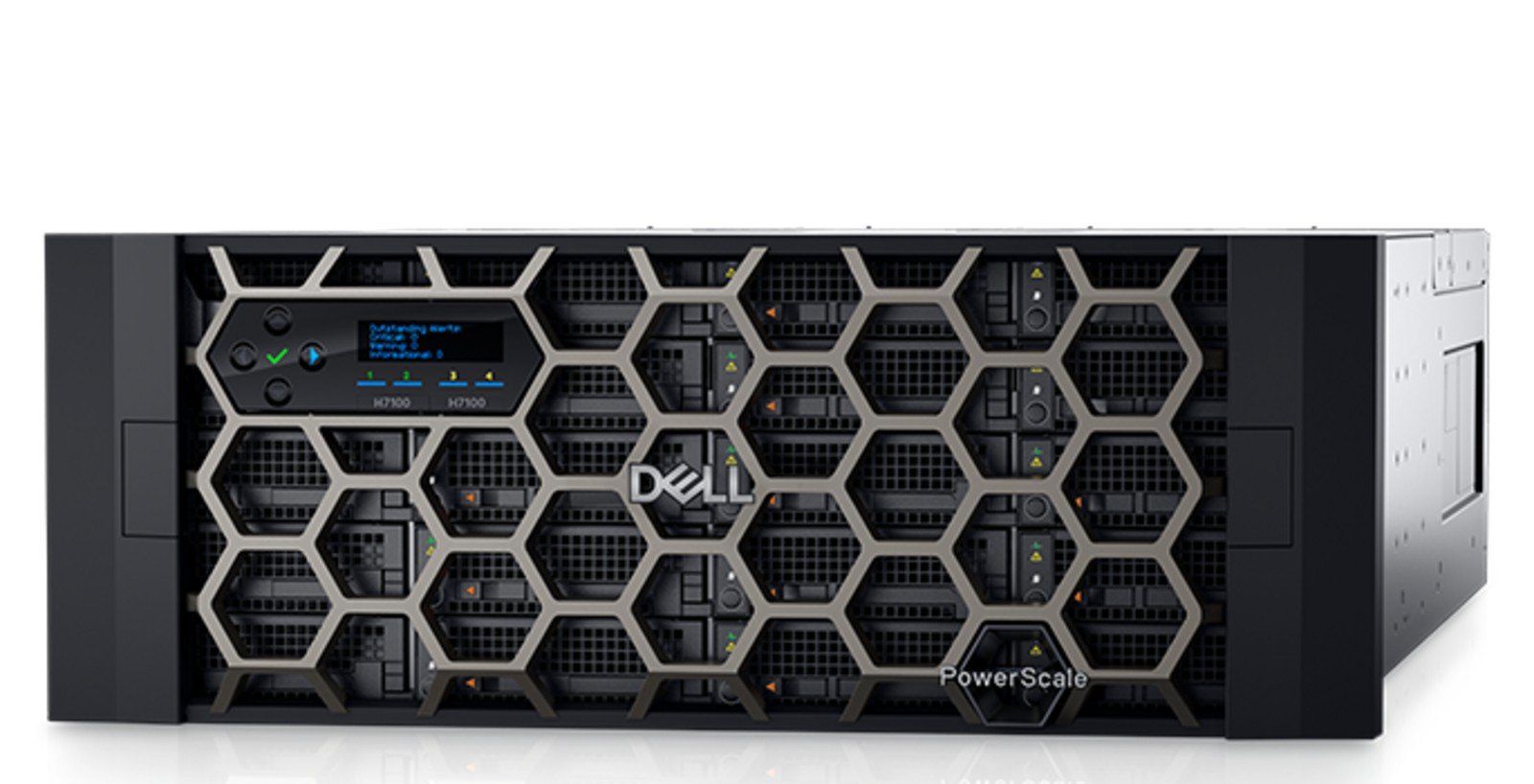
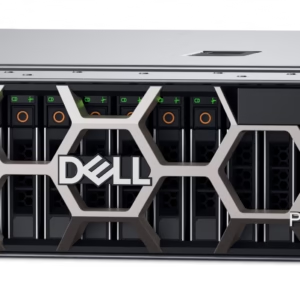
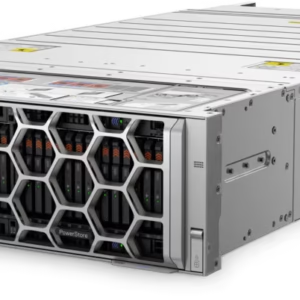
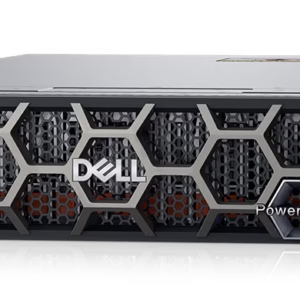
PowerScale H7100 Hybrid NAS Platform
The Dell PowerScale H7100 Hybrid NAS Platform is a four-node hybrid platform in the PowerScale scale-out NAS family, with 80 x 3.5-inch HDD bays per chassis, 384 GB of ECC memory per node and up to 2.5 PB per chassis. It scales from 960 TB to 100.8 PB raw. OneFS provides a single namespace across all nodes.
PowerScale H7100 Hybrid NAS Platform Overview
The PowerScale H7100 succeeds the H7000 as Dell’s most powerful and scalable hybrid platform, delivering up to 1.9 PB per chassis on a redesigned thermal and compute architecture. With refreshed CPUs, DDR5 memory, NVMe vaulting and support for future higher-capacity HAMR drives, it enhances responsiveness for archive-heavy workloads that need more than cold storage, enabling intelligent tiering, active archive and high-capacity performance workflows in one infrastructure.
The PowerScale H7100 Hybrid NAS Platform is a four-node Hybrid platform in the PowerScale scale-out NAS family. Four
self-contained nodes share a single 4U chassis, and every node runs the PowerScale OneFS operating
system, so nodes can be added to an existing PowerScale or Isilon cluster without downtime and
without migrating data. Hybrid nodes are node-pool compatible with their predecessors, which
makes expansion of an existing cluster straightforward.
Capacity and Drives
- Chassis form factor: 4U chassis, 4 nodes per chassis
- HDD bays: 80 x 3.5-inch HDD bays per chassis (20 per node)
- HDD sizes supported: 12 TB, 16 TB, 20 TB, 24 TB, 32 TB
- Chassis capacity: 960 TB (12 TB HDD)
1.28 PB (16 TB HDD)
1.6 PB (20 TB HDD)
1.9 PB (24 TB HDD)
2.5 PB (32 TB HDD) - Raw cluster capacity: 960 TB to 100.8 PB raw
- Self-encrypting drives: FIPS 140-2 for 2 TB to 16 TB drives
FIPS 140-3 (CMVP pending) for 20 TB drives and above
Compute and Memory
- ECC memory: 384 GB per node
- Cache SSD: 3.2 TB or 7.68 TB SSD, 1 or 2 per node
Capacity and number of SSDs determined by HDD size and count - Nodes per chassis: 4
- Nodes per cluster: 4 to 252
- Chassis per cluster: 1 to 63
Connectivity
- Front-end networking: 2 x 100GbE (QSFP28) or 2 x 25GbE (SFP28) per node
- Infrastructure (back-end) networking: 2 InfiniBand connections with EDR links, or 2 x 100GbE (QSFP28), or 2 x 25GbE (SFP28) per node
Operating System and Software
Every node runs the PowerScale OneFS distributed file system, which presents an entire cluster
as a single file system with a single global namespace. OneFS is fully journaled, fully
distributed and keeps a globally coherent write and read cache across all nodes.
- Scale-out architecture: distributed fully symmetric clustered architecture that
combines modular storage with the OneFS operating system in a single volume, single namespace and
single file system - Modular design: four self-contained nodes per chassis, each including server,
software, HDDs and SSDs, all integrated into a 4U rack-mountable enclosure - High availability: no single point of failure, with a self-healing design that
protects against disk or node failure and includes back-end intra-cluster failover - Automated storage tiering: policy-based tiering with SmartPools and CloudPools
to optimise storage resources and lower costs - Efficiency: SmartDedupe data deduplication plus inline data reduction and
compression - Data replication: SyncIQ one-to-many asynchronous replication between clusters,
and SmartSync for file-to-file and file-to-object data movement - Data retention: SmartLock policy-based retention and protection against
accidental deletion - Network protocol support: NFSv3, NFSv4, NFS Kerberized sessions (UDP or TCP),
SMB1 (CIFS), SMB2, SMB3, SMB3-CA, Multichannel, HTTP, FTP, NDMP, SNMP, LDAP, HDFS, S3, ADS and
NIS reads and writes
Data Protection and Security
FlexProtect file-level striping supports N+1 through N+4 and mirroring protection schemes, and
two-way NDMP is available over Fibre Channel and 10GbE. File system auditing and STIG hardening
address regulatory compliance requirements, and PowerScale Cyber Protection powered by Superna
Ransomware Defender can be included.
Physical Specifications
- Height: 7 inch (17.8 cm)
- Width: 17.6 inch (44.8 cm)
- Minimum service clearances: front 40 inch (88.9 cm), rear 42 inch
(106.7 cm)
Operating Environment
Compliant with ASHRAE A3 data center environment guidelines. Energy Star certification for the
new generation is coming soon.
Services and Warranty
Dell ProSupport with deployment and consulting services. ProSupport Plus is optionally available
with proactive and preventative services.
Ordering
Configuration, availability and lead time depend on the required model, drive mix, protocols and delivery destination. Send your requirement to receive a quotation.
Power and Heat Dissipation
- Power supplies: Dual-redundant, hot-swappable 1800 W power supplies with power factor correction, rated for 180 – 265 VAC (optional rack-mount step-up transformer for 90 – 130 VAC regions)
- Maximum power consumption: 2252 W per chassis at 25 C
- Typical power consumption: 1968 W per chassis
- Airflow: 59.3 CFM per node, 237.2 CFM per chassis (maximum)
- Depth: 40.4 inch (102.6 cm) front NEMA rail to rear 2.5-inch SSD cover ejector
42.2 inch (107.1 cm) front of bezel to rear 2.5-inch SSD cover ejector - Weight: 313 lb (142 kg) maximum per chassis