| Processor | 2 Intel® Xeon® CPUs, 2.6GHz/24C |
|---|---|
| Functional | All-flash, all-NVMe NAS |
| Memory | 512 GB DRAM DDR5 |
| System Overview | Base enclosure |
| Expansion Capacity | Scale-out architecture |
| Connectivity | Front End Networking (per node): |
| Media Types | NVMe SSDs |
| Software | OneFS 9.8 or later. Upgrades are non-disruptive. |
| Data Optimization | Efficiency |
| Data Protection | FlexProtect file-level striping with support for N+1 through N+4 and mirroring data protection schemes. |
| Security | Data at Rest Encryption with External Key Manager |
| Physical | Base unit |
| Power | 1400 W |
| Regulatory | Dell Information Technology Equipment is compliant with all currently applicable regulatory requirements for Electromagnetic Compatibility, Product Safety, and Environmental Regulations where placed on market. Detailed regulatory information and verification of compliance is available at the Dell Regulatory Compliance website. |
| Certifications | US Department of Defense: DoDIN APL – in process |
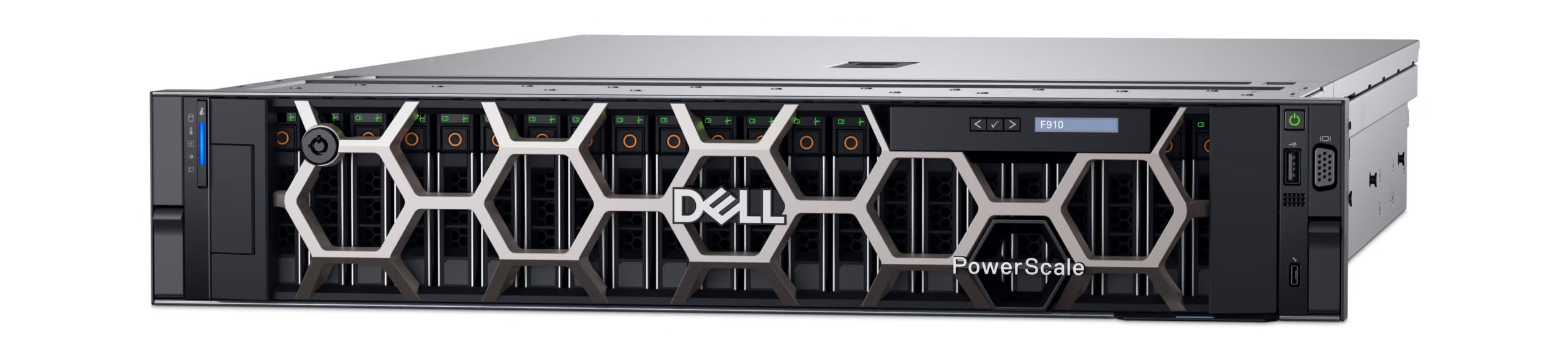

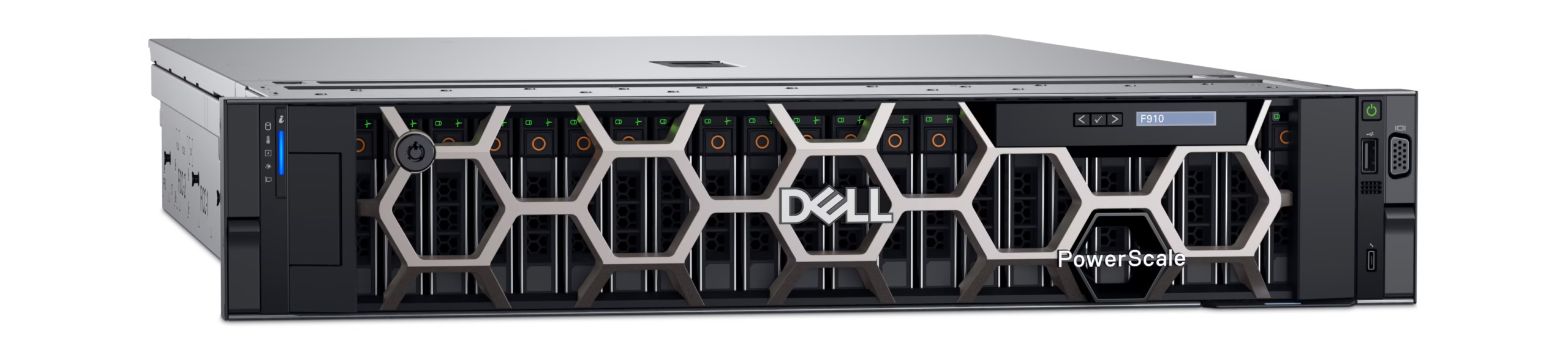
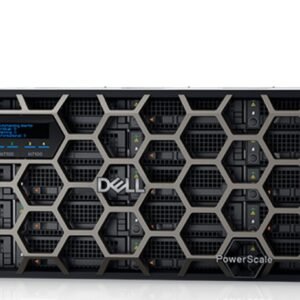
PowerScale F910 All-Flash NAS Platform
Overview
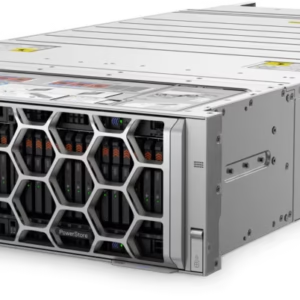
The PowerScale F910 All-Flash NAS Platform is a Dell PowerScale all-flash, all-NVMe scale-out NAS platform. Each 2U node scales from 3 to 252 nodes, delivering 92 TB~2.9 PB of raw capacity per node and 276 TB~737 PB per cluster.
At a glance
- Processor: 2 Intel® Xeon® CPUs, 2.6GHz/24C
- Functional: All-flash, all-NVMe NAS; Scale-out storage
- Memory: 512 GB DRAM DDR5
- System Overview: Base enclosure; 2U Form Factor; 24×2.5” NVMe SSD drives
- Expansion Capacity: Scale-out architecture; Distributed fully symmetric clustered architecture that combines modular storage with OneFS operating system in a single volume, single namespace, and single filesystem.; Expansion enclosures; Minimum cluster size: 3 nodes; Maximum cluster size: 252 nodes
- Connectivity: Front End Networking (per node):; Dual port 25G NIC supporting 10G or 25G connections (SFP+/SFP28); Dual port 100G NIC supporting 40G or 100G connections; Infrastructure Networking (per node):; 2 InfiniBand connections with QDR links or Dual port 100G NIC supporting 40G or 100G connections (QSFP+/QSFP28)
- Media Types: NVMe SSDs; 3.84 TB (TLC); 7.68 TB (TLC); 15.36 TB (QLC); 30.72 TB (QLC)
- Software: OneFS 9.8 or later. Upgrades are non-disruptive.; PowerScale OneFS distributed file system creates a cluster with a single file system and single global namespace. It is fully journaled, fully distributed, and has a globally coherent write/read cache.
- Data Optimization: Efficiency; SmartDedupe data deduplication option, which can reduce storage requirements by up to 35 percent. Inline data reduction and compression.; 2:1 DRR guarantee; Network protocol support; NFSv3, NFSv4, NFSoRDMA, NFS Kerberized sessions (UDP or TCP), SMB1 (CIFS), SMB2, SMB3, SMB3-CA, Multichannel, HTTP, FTP, NDMP, SNMP, LDAP, HDFS, S3, ADS, NIS reads/writes.; Automated storage tiering; Policy-based automated tiering options including SmartPools and CloudPools software to optimize storage resources and lower costs.; Data retention; SmartLock policy-based retention and protection against accidental deletion.; Data replication; SyncIQ fast and flexible one-to-many file-based asynchronous replication between clusters. SmartSync provides efficient file to file and file to object data movement.
- Data Protection: FlexProtect file-level striping with support for N+1 through N+4 and mirroring data protection schemes.; File system audit capability and STIG hardening to improve security and control of your storage infrastructure and address regulatory compliance requirements, with our Cyber Protection Suite.
- Security: Data at Rest Encryption with External Key Manager; Data in flight encryption; Role-Based Access Control (RBAC); Multi-factor authentication; Secure Boot; Auditing; Anti-Virus
- Physical: Base unit; Height: 86.8 mm / 3.41 in.; Width: 482 mm / 18.97 in.; Depth: 772.13 mm / 30.39 in. with bezel; Weight: 32.75 kg / 72.2 lbs.
- Power: 1400 W; Dual redundant power supplies; Max Power consumption; (200-240V per node); @25°C – 877 Watts; @35°C – 913 Watts; Typical Thermal rating:; @25°C – 2992 BTU/hr; @35°C – 3115 BTU/hr
- Regulatory: Dell Information Technology Equipment is compliant with all currently applicable regulatory requirements for Electromagnetic Compatibility, Product Safety, and Environmental Regulations where placed on market. Detailed regulatory information and verification of compliance is available at the Dell Regulatory Compliance website.
- Certifications: US Department of Defense: DoDIN APL – in process; Common Criteria EAL2 – in process; IPv6 USGv6-R1 certification – in process; Energy Star Certification – In process; View Data Sheet; View Spec Sheet; Try PowerScale; Experience PowerScale management with self-paced virtual labs in free, real-time virtual environments.; Browse hands-on labs; Achieve multicloud agility across cloud environments; Simplify operations with consistent user experience, on-premises or in the cloud.; Run workloads anywhere with seamless data mobility across environments.; Accelerate AI workloads with native AI tools in the cloud.; Explore cloud storage services with PowerScale; Drive AI innovations faster and more efficiently; Support uninterrupted model training and prevent GPU idling with up to PBs of storage.; Linearly scale up to 252 nodes per cluster to efficiently scale as your AI data grows.; Realize uncompromising performance with an ethernet-based storage appliance certified by NVIDIA DGX SuperPOD.; Read about PowerScale AI solutions; Ensure cyber security and resiliency with PowerScale OneFS; Detect, and recover with smart air-gap technology, event triggers, and Zero Trust API.; Enable enhanced data availability with AI-powered detection and rapid recovery.; Ensure hardware resilience with 6x9s availability for nondisruptive uptime.; Read the PowerScale cyber protection eBook
When to choose this storage system
Choose it for unstructured data — AI and GPU pipelines, analytics, HPC, media and genomics. OneFS serves NFS, SMB and S3 from a single namespace, so capacity and performance grow linearly as nodes are added.
Reading the specifications
capacity and controller count set the usable scale and performance headroom; memory and processing power drive cache and metadata performance; supported protocols decide which hosts and applications can attach; media type (NVMe TLC/QLC) sets the latency and cost profile; data-reduction, protection and security features set the resilience level.
Platform & compatibility
Clients connect over NFSv3 and the wider protocol list above, on the OneFS scale-out filesystem. Confirm the host OS, protocol, capacity and controller configuration for your environment before ordering.
Deployment notes
The PowerScale F910 All-Flash NAS Platform is supplied as a configured system; capacity, controllers and licensing are selected at order time. Availability, firmware and licensing are confirmed against the current release at order time. Send the required capacity, protocol and performance target for a firm configuration and quote.
FAQ
How far does it scale? 3 to 252 nodes, 276 TB~737 PB of raw capacity.
What is the node form factor? 2U node.
What protocols does it serve? NFS, SMB/CIFS, S3, HDFS, NFSoRDMA and more (see above).
How do I get pricing? Send the required capacity and topology; quotes depend on quantity, options and destination.
Related
Configuration, availability and lead time depend on the required quantity, deployment topology and delivery destination. Send your requirement to receive a quotation.